
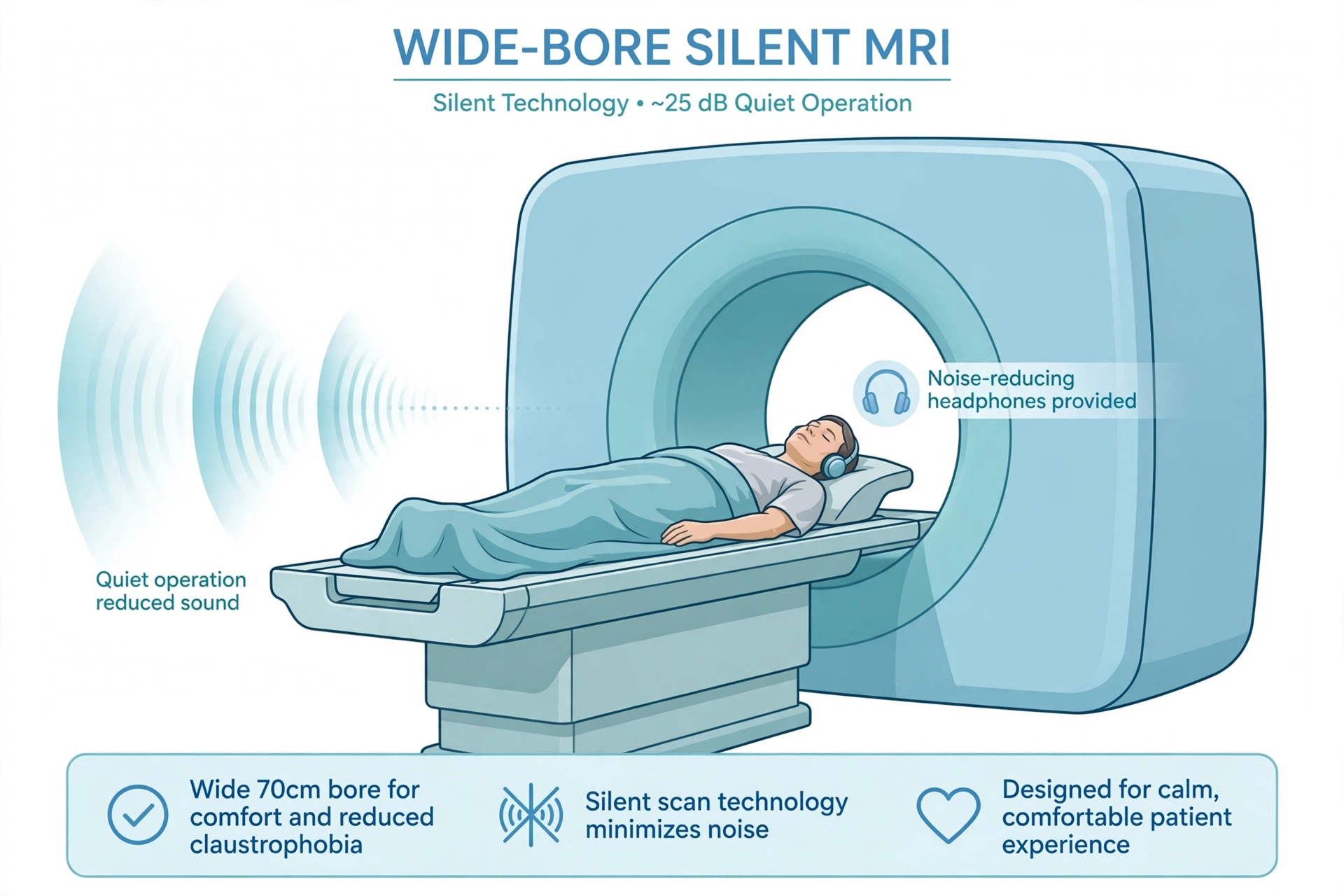
For many people, the hardest part of an MRI is not the scan itself — it is the thought of lying inside a narrow tunnel while loud knocking and buzzing sounds echo around them. If you feel anxious about this, you are not alone. Fear of enclosed spaces and sensitivity to noise are among the most common reasons people postpone or avoid MRI scans.
Modern MRI technology has an answer: Silent 3T MRI, which combines a powerful 3 Tesla magnet with noise-reduction technology for a noticeably calmer scanning experience.
Why Do Some People Find MRI Difficult?
A conventional MRI scanner is a long, tube-like machine. During the scan you lie on a table that slides into the bore, and you need to remain still while the machine captures images. Two things bother patients most:
- The confined space. Standard MRI bores are about 60 cm wide, which can feel tight, especially for people who are claustrophobic or broad-built.
- The noise. MRI scanners make loud knocking, buzzing, and chirping sounds as the magnetic coils switch on and off rapidly. A conventional scan can be as loud as a busy road, and patients are given earplugs or headphones to cope.
A scan can also take 20 to 45 minutes depending on the body part, which can feel long when you are already uneasy.
What Does “3T” Mean?
The “T” stands for Tesla, the unit used to measure the strength of the scanner’s magnet. A 3T scanner has a magnetic field roughly twice as strong as the widely used 1.5T scanner.
A stronger magnet produces a stronger signal from the body’s tissues, which generally means sharper, more detailed images — particularly useful for brain, spine, joint, and blood vessel imaging. In many cases, the extra signal can also be used to complete the scan faster. Image quality, however, also depends on the coils, software, and the expertise of the radiologist.
What Makes It “Silent”?
The loud noises in MRI come from vibrations in the gradient coils — the parts of the machine that switch magnetic fields rapidly to build the image. Silent-scan technology changes the way these coils are driven, smoothing out the rapid switching so that the acoustic noise drops dramatically.
Instead of the familiar loud knocking, a silent scan produces only a soft background hum. Patients often describe the difference as remarkable — many find they can relax, and some even doze off during the scan. It is worth noting that the scan is quieter, not completely soundless, and you will still hear gentle sounds as different image sequences run.
Wide Bore: More Room to Breathe
Many modern 3T scanners, including silent models, come with a wider bore — typically around 70 cm instead of 60 cm. Those extra centimetres make a real psychological difference: there is more space around your shoulders and face, more light reaches you, and the feeling of confinement is reduced. For claustrophobic patients, the combination of a wider opening and a quiet scan addresses the two biggest sources of discomfort at once.
Who Might Find Silent 3T MRI Helpful?
A quieter, roomier scan can make the experience easier for:
- People who feel anxious or claustrophobic in enclosed spaces
- Children and elderly patients who are sensitive to loud noises
- Anyone who has previously found an MRI scan distressing
- Patients who need longer or more detailed scans, such as brain or spine studies
That said, the type of scanner is only one part of the experience. If you are very anxious, tell the imaging centre in advance — staff who perform MRI scans every day are used to nervous patients and can suggest practical steps, such as keeping your eyes closed, using an eye mask, or taking short breaks between sequences if the protocol allows.
What Hasn’t Changed: Safety and Preparation
Silent technology changes the comfort of the scan, not its medical fundamentals:
- You still need to lie still. Movement blurs MRI images, so staying still remains important for a clear result.
- Metal screening still applies. MRI uses a powerful magnet, so you will be asked about implants, pacemakers, surgical clips, and other metal in or on your body before the scan. Always answer these questions carefully.
- Contrast may still be needed. For some scans, the doctor may advise a contrast injection to highlight certain tissues. This is a medical decision your doctor makes.
- Scan time is similar. While 3T can be faster for some sequences, a detailed study still takes time.
Your doctor’s prescription determines whether an MRI is needed and which type is appropriate — the imaging centre will match the protocol to the referral.
Tips for a Calmer Scan
- Communicate beforehand. Mention your anxiety when booking so the staff can plan accordingly.
- Ask what to expect. Knowing the steps — how long each sequence lasts, when you can breathe normally — reduces uncertainty.
- Use the call button. You are given a squeeze-ball or button to alert the technologist at any time; you are never truly alone.
- Focus on breathing. Slow, steady breathing helps many patients relax.
- Consider a companion. Many centres allow someone to stay in the room with you during the scan.
Medical Disclaimer
This article is for general information only and is not medical advice. MRI suitability depends on your medical history, implants, and your doctor’s assessment. If you have questions about whether an MRI is right for you, please consult your doctor.
Book Your MRI at Aura Care Centre
Aura Care Centre offers Silent 3T MRI scanning in a patient-friendly setting, with branches in Sector 38, Sector 15, and Sector 51, Gurugram. Our team is experienced in helping anxious patients through their scans comfortably. To book your MRI, call +91 81301 01433 or message us on WhatsApp — we will guide you through preparation and scheduling.