
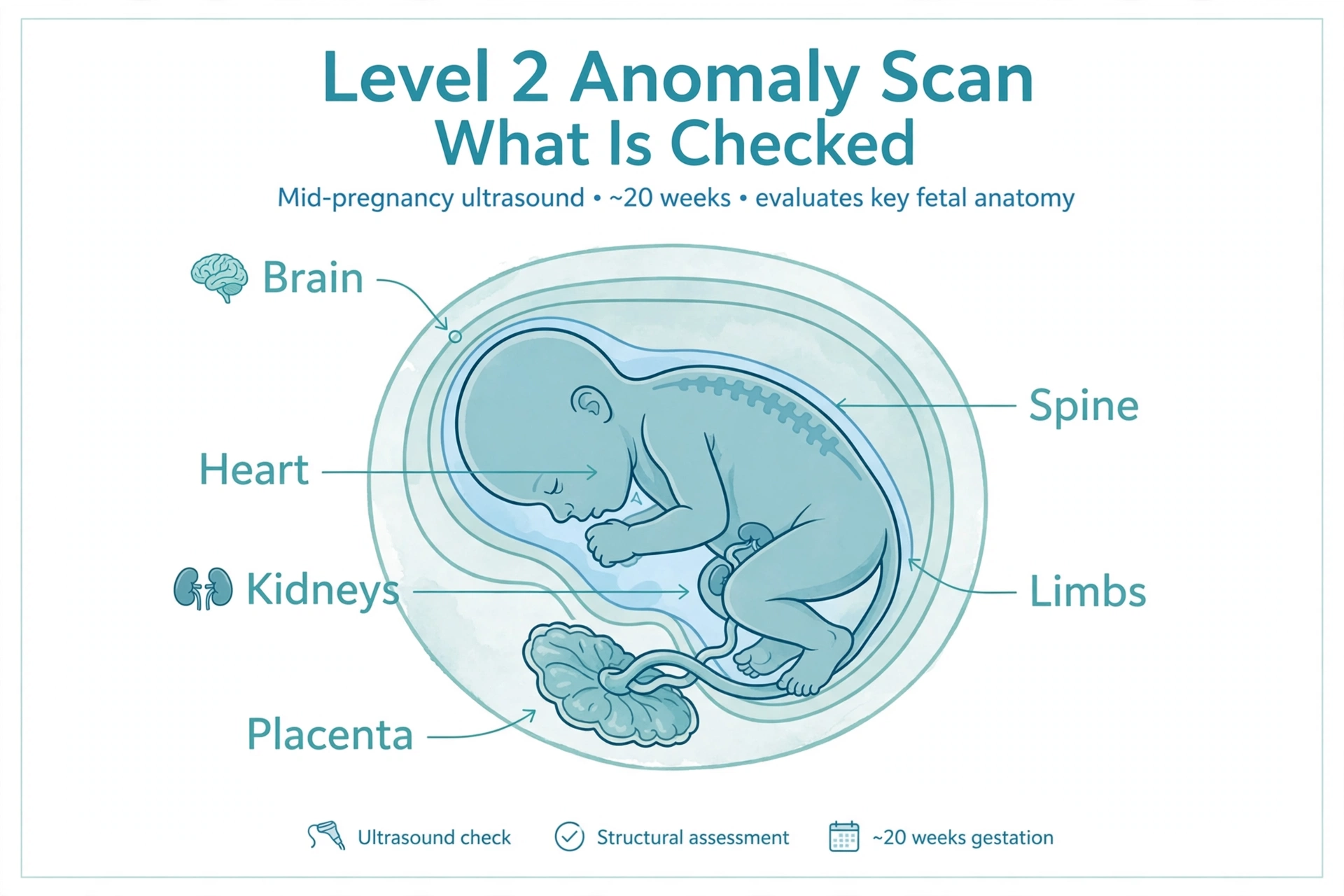
The mid-pregnancy ultrasound — commonly called the level 2 scan or anomaly scan — is widely regarded as one of the most detailed ultrasounds of pregnancy. Unlike the early scans that mainly confirm the pregnancy and estimate the due date, this one takes a careful, organ-by-organ look at how your baby is developing.
If your doctor has advised this scan, here’s what it involves, when it’s done, and how to prepare — in plain language.
What Is a Level 2 Anomaly Scan?
A level 2 scan is a detailed, targeted ultrasound examination of the fetus, usually performed in the second trimester. It is also referred to as a targeted imaging for fetal anomalies (TIFFA) scan.
While a routine growth scan measures the baby’s size, the anomaly scan goes further: the sonologist systematically examines the baby’s brain, face, heart, spine, abdominal organs, limbs, placenta, and amniotic fluid to check that development is proceeding normally.
It is a screening examination — it assesses the baby’s anatomy in detail but does not guarantee the detection of every possible condition, and a normal scan is reassuring but not an absolute guarantee.
When Is the Best Time for an Anomaly Scan?
The scan is usually scheduled between 18 and 22 weeks of pregnancy. This window is chosen for a practical reason: the baby’s organs are developed enough to be seen clearly, yet the baby is still small enough for the sonologist to get a good view of each structure.
Scanning too early may mean some organs are not yet clearly visible; scanning much later can be harder because the baby has less room to move into a good position. Your doctor will advise the exact timing based on your pregnancy.
What Does the Sonologist Check?
The scan follows a checklist covering the baby’s anatomy from head to toe. Typical areas examined include:
- Head and brain — skull shape, brain structures such as the ventricles and cerebellum
- Face — profile, lips (to check for cleft lip), nasal bone
- Spine — the vertebrae along the length of the back
- Heart — the four chambers and the major blood vessels leaving the heart
- Abdomen — stomach, kidneys, bladder, and the abdominal wall
- Limbs — the long bones of the arms and legs, hands and feet
- Umbilical cord — usually checked for three vessels (two arteries and one vein)
- Placenta — its position and relationship to the cervix
- Amniotic fluid — the amount of fluid surrounding the baby
- Cervix — sometimes measured to assess the risk of preterm labour, when advised
The sonologist also takes standard measurements (head, abdomen, thigh bone) to confirm the baby’s growth is on track for the gestational age.
How Should You Prepare?
In most cases, no special preparation is needed for an anomaly scan. Unlike some abdominal ultrasounds, a full bladder is usually not required at this stage of pregnancy.
A few practical tips:
- Wear comfortable, loose clothing that’s easy to adjust
- Carry your previous scan reports and prescriptions — the sonologist may want to compare
- The scan can take 30 to 45 minutes, sometimes longer if the baby is in a position that makes some views difficult
- Eating something light before the scan is fine; some mothers find the baby moves more after a snack, which can help
What Happens During the Scan?
You’ll lie on an examination couch while a water-based gel is applied to your abdomen. The sonologist moves a handheld probe (transducer) over your belly to capture images of the baby. The gel may feel slightly cool, and you may feel gentle pressure, but the procedure is painless.
The sonologist works quietly through the checklist, freezing images and taking measurements. You can usually watch the screen. At the end, you’ll receive a report with the findings and measurements, which your doctor will explain to you.
If the baby is curled up in a position that hides the heart or face, you may be asked to walk around briefly or come back after a short break — this is common and nothing to worry about.
What If Something Needs a Closer Look?
Sometimes the sonologist spots something that needs a second opinion or a repeat scan — for example, a structure that couldn’t be seen clearly, or a finding that needs a specialist’s review. This does not automatically mean something is wrong. In many cases, a repeat scan with a clearer view resolves the question.
If a finding is confirmed, your doctor will discuss what it means, what further evaluation (if any) is appropriate, and what your options are. The purpose of the scan is precisely to give you and your doctor this information early, when there is time to plan.
Is the Anomaly Scan Safe?
Yes. Ultrasound uses high-frequency sound waves — not X-rays — and it has been used in pregnancy for decades with an established safety record. There is no radiation involved, and the scan is non-invasive. It is routinely recommended as part of standard antenatal care.
Medical Disclaimer
This article is for general information only and is not a substitute for professional medical advice, diagnosis, or treatment. Every pregnancy is different. Always follow your doctor’s guidance about which scans you need and when, and discuss any concerns about your pregnancy directly with your treating doctor.
Book Your Anomaly Scan at Aura Care Centre
Aura Care Centre offers detailed level 2 anomaly scans performed on advanced 3D/4D ultrasound systems, with clear digital reports you can share with your doctor. Visit us at our centres in Sector 38, Sector 15, or Sector 51, Gurugram. Call or WhatsApp us at +91 81301 01433 to book your appointment.