It’s one of the most common questions patients ask before a CT scan: “Is it safe? What about the radiation?” It’s a fair question — and the honest answer is nuanced. CT scans do use ionising radiation, but modern scanners use far less of it than older machines, and the scan is only ordered when the medical benefit outweighs the small risk. Here’s what you should know.
How a CT Scan Works
A CT (computed tomography) scan uses X-rays taken from many angles around the body. A computer combines these into detailed cross-sectional images — “slices” — of bones, organs, blood vessels, and soft tissues. It can reveal things a plain X-ray cannot: internal injuries, tumours, blood clots, infections, and complex fractures.
A CT scan takes only a few minutes of actual scanning time, though preparation and positioning add to the visit. For some scans, a contrast dye is injected to make blood vessels or organs show up more clearly.
Yes, CT Uses Radiation — Here’s the Context
Unlike MRI or ultrasound, which use no ionising radiation, CT does expose you to a dose of X-ray radiation. Radiation at high doses can damage cells, which is why the question of safety is legitimate.
But context matters enormously:
- We all receive radiation every day. Natural background radiation — from the sun, the soil, even the air — exposes everyone to a small continuous dose. A useful way doctors think about CT doses is to compare them with this background exposure.
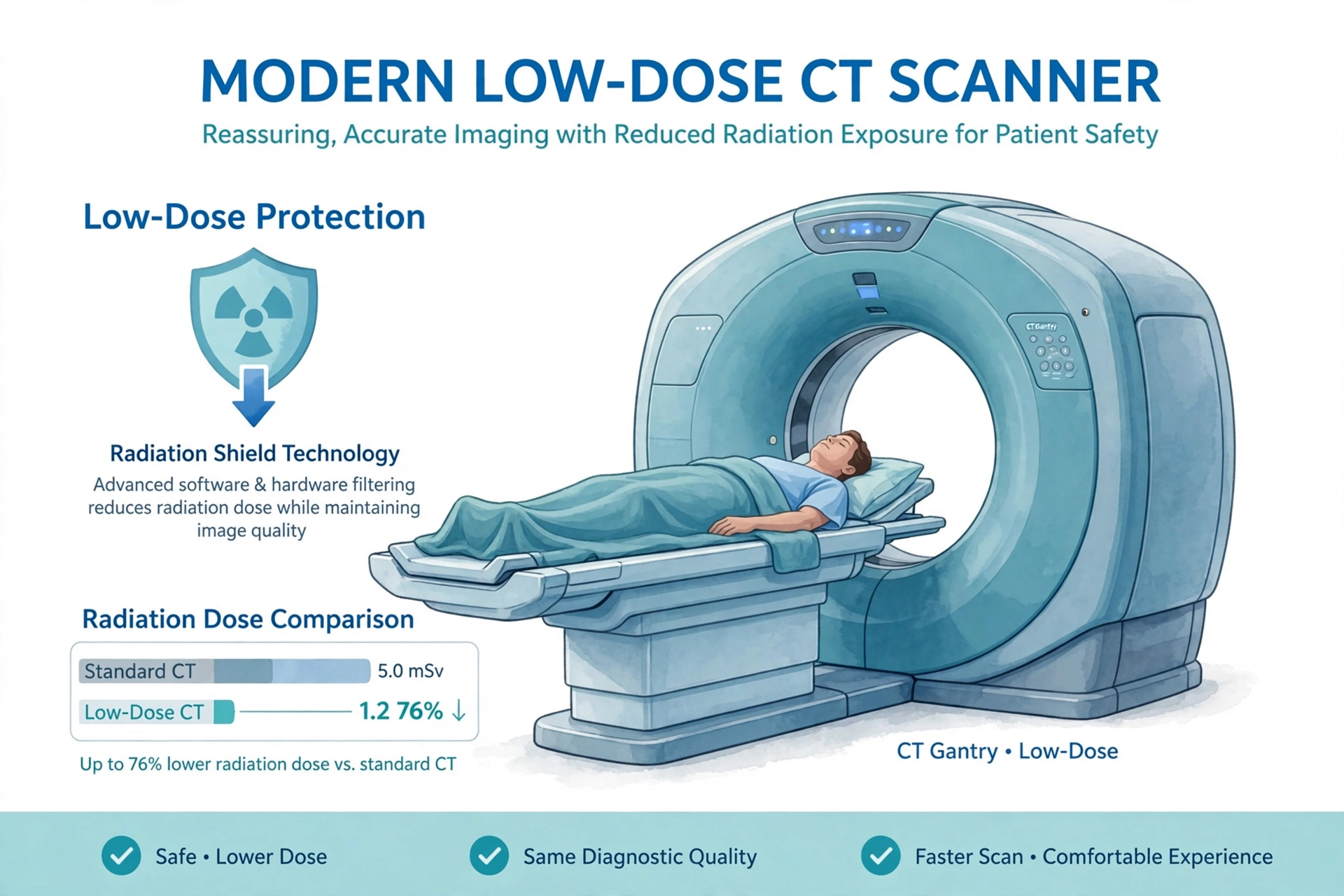
- Doses have fallen dramatically. A modern multi-slice CT scanner using current low-dose protocols delivers a fraction of the radiation that CT machines delivered 15–20 years ago. Advances in detector technology and image-reconstruction software mean clear images can now be produced with much less dose.
- The dose depends on what’s being scanned. A CT of the head uses less radiation than a CT of the abdomen and pelvis, because the area covered is smaller and the tissues differ. Your radiologist selects the protocol matched to the clinical question — no more, no less.
As a rough, widely cited comparison: the radiation from a single CT scan is often described as equivalent to somewhere between several months and a few years of natural background radiation, depending on the type of scan. These are approximations, not precise figures — and your centre’s radiologist can explain the specific protocol being used for your scan.
The Benefit-versus-Risk Principle
In medicine, every CT scan follows a simple principle: the scan should only be done when the information it provides is expected to change your care for the better. Doctors call this “justification.”
Consider what a CT can do in minutes: identify a brain bleed after a head injury, locate the source of severe abdominal pain, stage a cancer, or guide an emergency surgery. In these situations, the value of a fast, accurate diagnosis overwhelmingly outweighs the small theoretical risk of the radiation dose.
Problems arise only when CT scans are done without a clear medical reason — which is why a good centre will always ask for the doctor’s prescription and may discuss whether a non-radiation alternative (like ultrasound or MRI) could answer the same question.
How Modern Centres Keep Doses Low
A quality diagnostic centre follows the ALARA principle — “As Low As Reasonably Achievable.” In practice, this means:
- Low-dose protocols as the default, with higher-dose settings reserved for cases that genuinely need them
- Iterative reconstruction software that produces clear images from less raw data
- Automatic exposure control that adjusts the X-ray output to your body size — a smaller patient automatically receives less dose
- Limiting the scan range to only the anatomy that needs imaging
- Shielding of sensitive areas where appropriate
- Regular equipment calibration and quality checks
When choosing a centre, it’s reasonable to ask whether they use low-dose protocols. A centre that can answer confidently is a centre that takes dose seriously.
Special Considerations
Pregnancy: If you are pregnant or might be, tell your doctor and the scan centre before the scan. The decision involves weighing the urgency of the diagnosis against foetal radiation exposure. In many cases, ultrasound or MRI — which use no ionising radiation — can be used instead. But in emergencies (such as trauma), a CT may still be the right choice, with shielding and dose optimisation.
Children: Children are more sensitive to radiation than adults, and they have more years ahead for any theoretical risk to manifest. Paediatric CT protocols use significantly reduced doses, and doctors are especially careful to consider ultrasound or MRI first for children.
Contrast dye: Some CT scans use an iodine-based contrast agent. This is separate from the radiation question, but worth knowing: tell the staff if you have kidney problems, thyroid disorders, or a history of allergy to contrast dye. They will screen you before the scan.
Repeat scans: If you’ve had multiple CT scans, mention it. Keeping a personal record of your imaging history helps your doctor make informed decisions about future scans.
Questions Worth Asking Before Your Scan
- Why is this CT needed, and what will it change about my treatment?
- Could ultrasound or MRI answer the same question?
- Do you use low-dose protocols?
- Will I need contrast, and how should I prepare?
- How and when will I receive my report?
A centre that welcomes these questions is a centre you can trust.
Medical Disclaimer: This article is for general information only and is not medical advice. The decision to undergo a CT scan should always be made by your doctor based on your clinical situation. If you have concerns about radiation, discuss them with your doctor or radiologist before the scan.
Book your scan at Aura Care Centre — Our low-radiation multi-slice CT scanner, operated under strict dose-optimisation protocols, is available at our Gurugram centres. Reports for urgent scans are delivered within 2 hours. Call or WhatsApp us on +91 81301 01433 to book at Sector 38, Sector 15, or Sector 51.