
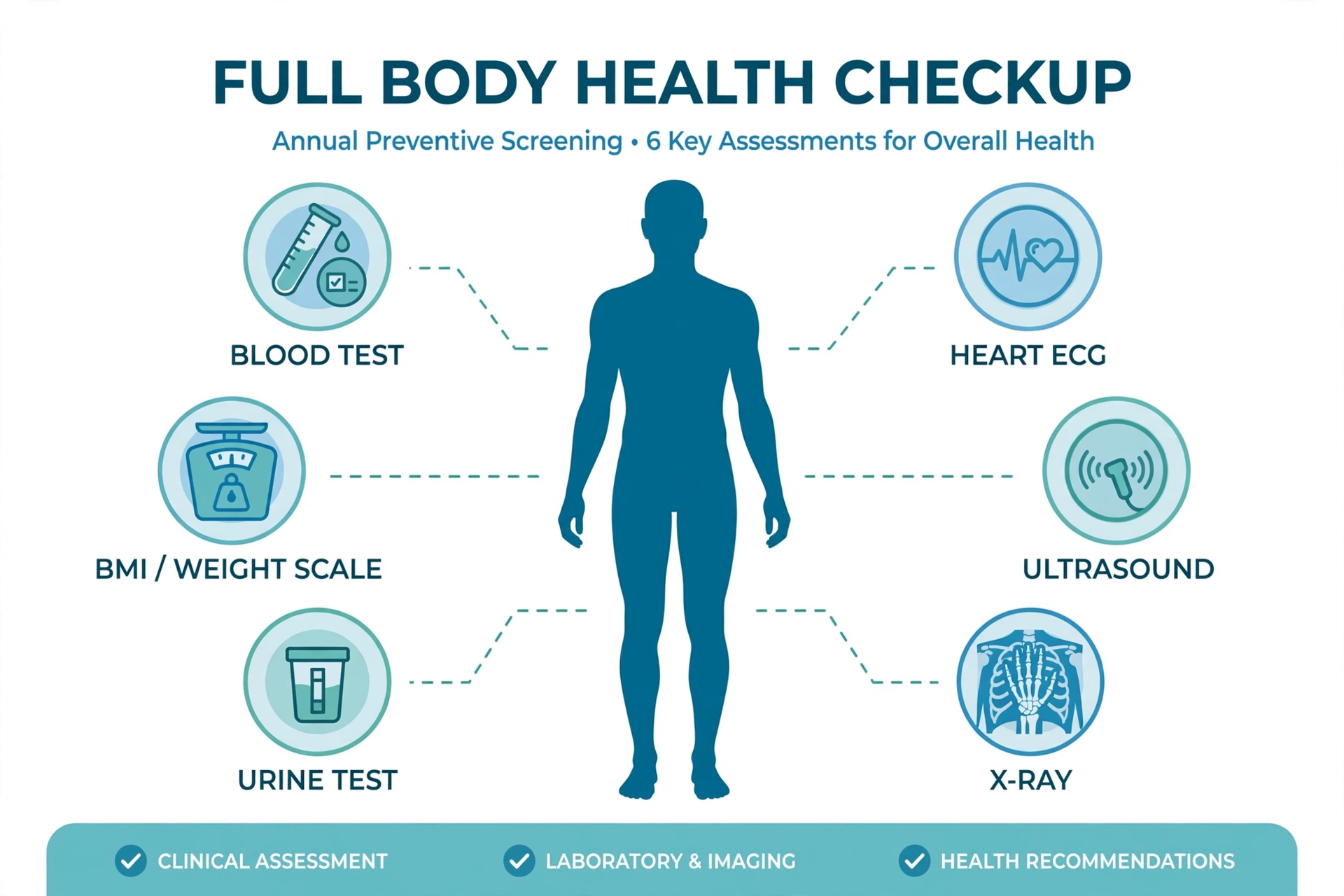
A full body health checkup — sometimes called a preventive health package or executive health check — is a bundled set of tests and examinations designed to assess your overall health and catch potential problems early. But what exactly is inside these packages, and how often do you actually need one? This guide breaks it down in plain language.
What a Full Body Checkup Is (and Isn’t)
A preventive health checkup is a screening exercise: it looks for risk factors and early signs of disease in people who feel healthy. It is not the same as a diagnostic workup, which investigates specific symptoms you already have.
The value of a checkup lies in early detection. Conditions like high blood sugar, high cholesterol, thyroid disorders, and vitamin deficiencies often cause no symptoms in their early stages. Finding them early gives you and your doctor the chance to act before complications develop.
No checkup can guarantee future health, and no package covers everything. Understanding what’s typically included helps you choose wisely — and discuss the right options with your doctor.
Typical Components of a Health Checkup Package
Packages vary between centres, but most full body checkups in India include some combination of the following. Think of these as the usual building blocks:
Blood tests (pathology):
- Complete Blood Count (CBC) — measures red cells, white cells, platelets, and haemoglobin; screens for anaemia and infection
- Blood sugar tests — fasting glucose and HbA1c (which reflects average sugar over ~3 months); screens for diabetes and pre-diabetes
- Lipid profile — total cholesterol, LDL, HDL, and triglycerides; assesses heart-disease risk
- Liver Function Test (LFT) — SGOT, SGPT, bilirubin, and proteins; checks liver health
- Kidney Function Test (KFT) — creatinine, urea, and electrolytes; checks kidney health
- Thyroid profile — T3, T4, and TSH; screens for hypo- and hyperthyroidism
- Vitamin D and B12 — commonly included given how widespread deficiencies are in India
- Urine routine — a basic screen for kidney issues, sugar, and infection
Imaging (where included):
- Ultrasound of the whole abdomen — looks at the liver, gallbladder, kidneys, pancreas, and other organs
- Chest X-ray — a basic view of the lungs and heart outline
- ECG — records the heart’s electrical activity; a basic cardiac screen
Measurements and examination:
- Blood pressure, height, weight, and BMI
- A general physical examination by a doctor
More comprehensive (“executive”) packages may add tests like treadmill stress tests (TMT), echocardiography, or advanced imaging — but these are usually recommended based on age and risk factors rather than included by default.
How to Choose the Right Package
Bigger is not always better. A few practical pointers:
- Start with your age and risk factors. A healthy 30-year-old and a 55-year-old with a family history of heart disease need different levels of screening. Your doctor can advise.
- Look at the test list, not the package name. Package names (“Silver,” “Gold,” “Platinum”) are marketing labels. The actual list of tests is what matters.
- Avoid duplicate testing. If you recently had a thyroid test or lipid profile, you may not need them repeated in the package.
- Ask what’s not included. Some packages exclude doctor consultation or report explanation — worth knowing in advance.
- Be wary of packages that promise to “detect everything.” No screening panel can do that, and such claims should be treated with scepticism.
How to Prepare
Most checkups require overnight fasting (usually 10–12 hours) because blood sugar and lipid tests are affected by food. Water is generally allowed. Your centre will give you specific instructions when you book — follow them, because an unfasted sample can distort results.
Other preparation tips:
- Avoid alcohol for 24–48 hours before the tests
- Get a normal night’s sleep if possible
- Carry your previous reports, if any, so trends can be compared
- Wear comfortable clothing, especially if an ECG or ultrasound is included
- Inform the staff about any medications you take
How Often Should You Get a Checkup
There is no single rule, but general guidance followed by most physicians:
- Under 30, healthy, no risk factors: a basic checkup every 2–3 years is reasonable
- 30–40: once every 1–2 years
- Above 40, or with risk factors (family history of heart disease, diabetes, hypertension, smoking): once a year
- With a known chronic condition: as often as your treating doctor advises — the package does not replace disease-specific monitoring
These are broad guidelines, not prescriptions. Your doctor may recommend a different interval based on your personal and family history.
What Happens After the Checkup
You will receive a consolidated report of all test results. Ideally, a doctor reviews the report with you and explains what the numbers mean in your context. Borderline or abnormal findings may lead to repeat testing, lifestyle advice, or referral to a specialist.
Keep your reports. A single set of numbers is a snapshot; the same tests repeated over years reveal trends — and trends are far more informative than any one reading.
Common Misconceptions
- “A normal checkup means I’m fully healthy.” It means no abnormalities were found in the tests done. It doesn’t rule out everything.
- “I feel fine, so I don’t need one.” Many conditions (high blood pressure, early diabetes, high cholesterol) are silent in their early stages. That is precisely the point of screening.
- “More tests are always better.” Unnecessary testing can lead to false alarms, anxiety, and follow-up procedures you didn’t need. Targeted testing, guided by a doctor, beats blanket testing.
Medical Disclaimer: This article is for general information only and is not medical advice. The decision to undergo a health checkup, and which tests to include, should be made in consultation with a qualified doctor who knows your medical history.
Book your health checkup at Aura Care Centre — Preventive health checkup packages with blood tests, ultrasound, X-ray, and ECG are available at our Sector 38, Sector 15, and Sector 51 centres in Gurugram. Call or WhatsApp us on +91 81301 01433 to choose the right package and book your slot.