Getting a blood test no longer requires a trip to the diagnostic centre. With home sample collection, a trained phlebotomist visits your home, collects the sample, and transports it to the lab under proper conditions. Here’s how the process works, who benefits most, and what to expect.
What Home Sample Collection Is
Home sample collection (sometimes called doorstep phlebotomy) is a service where, instead of you travelling to the lab, the lab comes to you. You book a slot, a trained professional arrives with sterile, sealed equipment, draws the blood sample at your home, labels and packs it, and delivers it to the laboratory for testing.
The tests performed on home-collected samples are the same as those done at the centre — CBC, thyroid, sugar, lipid profile, vitamin levels, dengue, and hundreds of others. The only difference is where the needle goes in.
How It Works: Step by Step
-
Booking. You call or message the centre with the tests your doctor has advised (a prescription or test list helps). You choose a date and time slot. Morning slots are popular because many tests require overnight fasting.
-
Confirmation. The centre confirms your slot and tells you how to prepare — usually fasting instructions and what to keep ready (your prescription, ID if required, a place to sit comfortably).
-
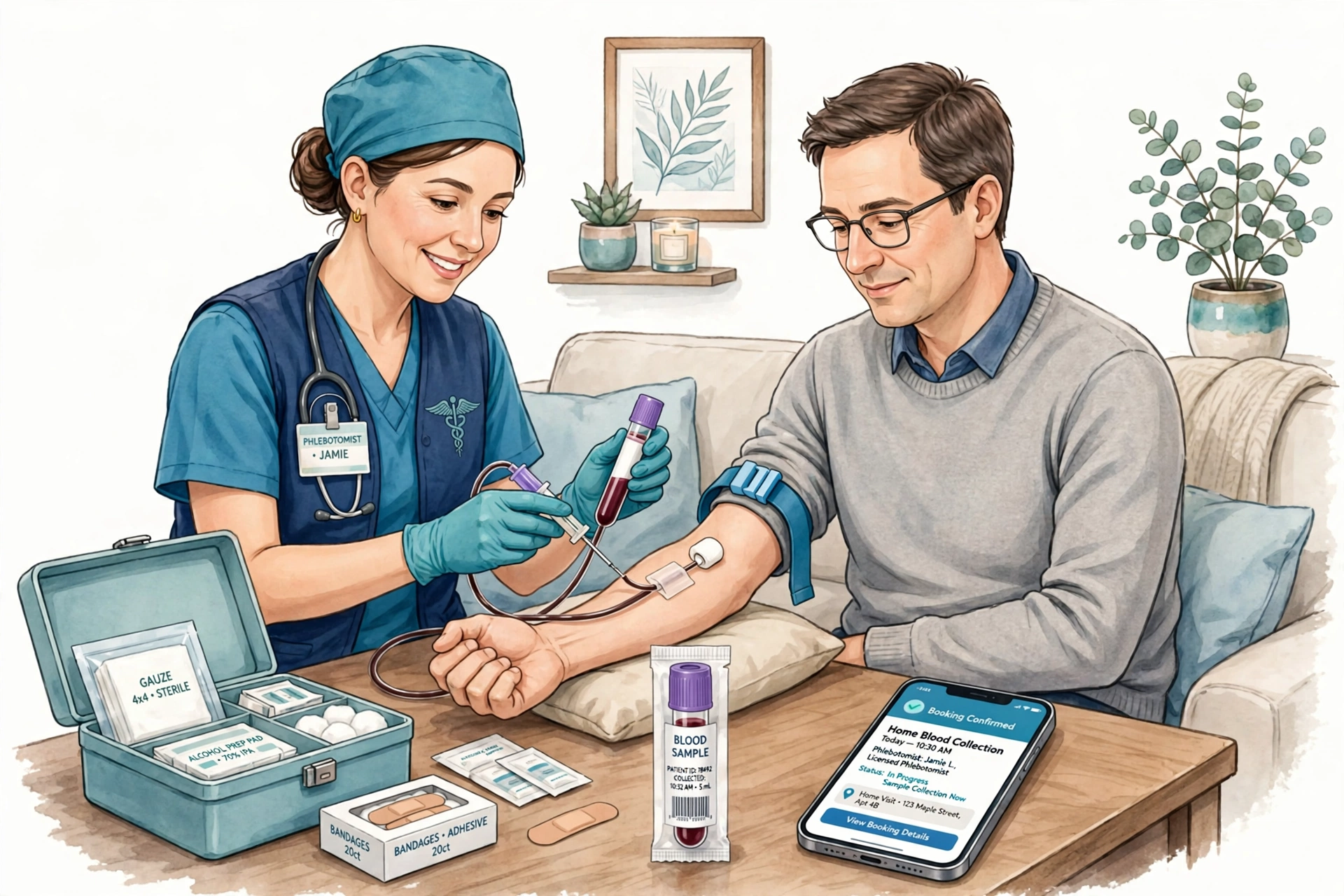
The visit. The phlebotomist arrives within the agreed window, carrying a kit with sealed sterile needles, vacutainer tubes, antiseptic, gloves, and a cold-chain transport box. They verify your identity and the tests ordered.
-
Sample collection. The process is the same as at any lab: a tourniquet, antiseptic swab, a quick venepuncture (usually from the arm), and the blood drawn into labelled tubes. It takes a few minutes. The phlebotomist applies a cotton ball and bandage afterwards.
-
Packing and transport. Tubes are sealed, labelled with your details, and placed in a temperature-controlled transport box. Time-sensitive samples reach the lab within the required window — this cold-chain handling is what keeps results reliable.
-
Testing and reporting. The lab processes your samples exactly as it would walk-in samples. Reports are typically delivered as PDFs on WhatsApp or email, usually the same day.
Who Benefits Most
Home collection is useful for anyone, but it’s especially valuable for:
- Elderly patients who find travel difficult or tiring
- Post-surgery or bedridden patients who can’t easily leave home
- Parents of young children who can’t step out for long
- Working professionals who prefer an early-morning slot before office hours
- People with contagious illnesses (like fever) who shouldn’t sit in a waiting room
- Anyone needing frequent repeat tests — for example, during pregnancy monitoring or chronic-disease follow-up
Is It Safe and Hygienic?
This is the right question to ask. A professional home-collection service should meet the same standards as the centre itself:
- Trained phlebotomists — not delivery staff; people specifically trained in venepuncture
- Single-use sterile equipment — needles and tubes opened in front of you, never reused
- Proper labelling — your name and details on every tube, verified with you
- Cold-chain transport — samples kept at the right temperature during transit
- Timely delivery to the lab — within the stability window for each test
Don’t hesitate to ask the centre about these points when booking. A reputable provider will answer without hesitation.
How to Prepare for a Home Visit
- Follow fasting instructions. If your tests need overnight fasting (usually 10–12 hours), schedule a morning slot and skip breakfast. Water is generally fine.
- Keep your prescription handy. It ensures the right tests are drawn — no missing tubes, no repeat visit.
- Choose a comfortable spot. A chair near a table with good light works well. The phlebotomist needs access to your arm.
- Stay hydrated (unless told otherwise) — it makes veins easier to find.
- Inform about difficult veins. If you’ve been told you have “difficult veins,” mention it — the phlebotomist will come prepared.
- Have someone around if you’re nervous. Especially for elderly patients or children, a family member’s presence helps.
What It Costs
Policies vary between centres. Some offer home collection free within their service area; others charge a nominal visit fee. When booking, ask upfront whether there’s a collection charge and which areas are covered — so there are no surprises.
Common Questions
Are home-collected results as accurate as centre-collected ones? Yes — provided the collection, labelling, and transport follow proper protocols. The analyser in the lab can’t tell where the sample was drawn. Accuracy depends on technique and handling, not location.
Which tests can’t be done at home? Most routine blood and urine tests can. Some specialised tests requiring immediate processing or specific collection conditions may need a centre visit — the booking team will tell you if any of your tests fall in this category.
How long does the visit take? Usually 10–15 minutes for the collection itself, plus a few minutes for verification and packing.
Can samples be collected for the whole family in one visit? Generally yes — mention it when booking so the phlebotomist brings enough supplies and allows extra time.
Medical Disclaimer: This article is for general information only and is not medical advice. The decision about which blood tests you need should always come from your doctor. Home sample collection is a convenience service and does not replace medical consultation.
Book home sample collection with Aura Care Centre — Our trained phlebotomists provide doorstep blood sample collection across Gurugram, with same-day PDF reports on WhatsApp. Call or WhatsApp us on +91 81301 01433 to book a slot at your convenience — serving Sector 38, Sector 15, Sector 51, and surrounding areas.