
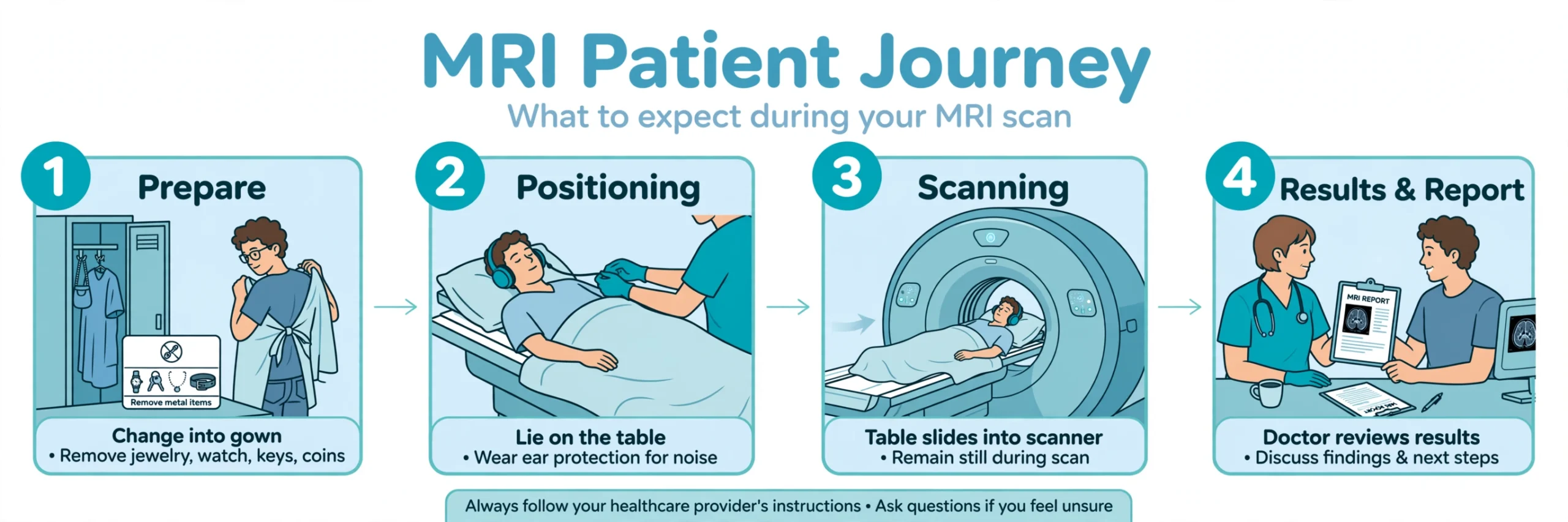
If your doctor has advised an MRI scan and you’ve never had one, it’s natural to feel a little nervous. What does the machine look like? Will it hurt? How long will you be inside? This guide walks you through the entire experience — before, during, and after — so you know exactly what to expect.
What an MRI Is
MRI stands for Magnetic Resonance Imaging. It uses a powerful magnet and radio waves — not X-rays — to create highly detailed images of organs, soft tissues, the brain, the spine, and joints. Because it shows soft tissue so clearly, it’s often the best tool for examining the brain, spinal cord, ligaments, and tumours.
An MRI scan is painless and non-invasive. The main challenges for patients are staying still and, for some people, managing the enclosed space and the noise. Knowing what’s coming makes both much easier.
Before Your Appointment: Preparation
Screening for metal. This is the most important part of MRI preparation. The scanner’s magnet is extremely powerful — strong enough to pull metal objects across the room. Before your scan, you’ll be asked about:
- Pacemakers, defibrillators, or other implanted electronic devices
- Metal implants, joint replacements, aneurysm clips, or surgical staples
- Cochlear implants
- Insulin pumps or medication patches
- Any history of metal fragments in the eyes (common in welders and metalworkers)
- Tattoos (most modern tattoo inks are safe, but mention them)
Many modern implants are MRI-compatible, but the radiologist needs to verify each one. Always inform the centre about any implant — even if a previous MRI was fine, protocols can differ between machines.
Clothing and valuables. You’ll be asked to remove all metal: jewellery, watches, hairpins, belts with metal buckles, and underwired bras. Many centres provide a gown to change into. Leave valuables at home if possible. Credit cards and phone should stay outside the scan room — the magnet can damage them.
Fasting. Most MRI scans don’t require fasting. The exception is abdominal or pelvic MRI, where you may be asked to fast for a few hours. Contrast-enhanced scans sometimes have their own instructions. Your booking confirmation will specify — if it doesn’t, ask.
Contrast dye. Some MRIs use a gadolinium-based contrast agent, injected into a vein, to highlight certain tissues. It’s different from CT contrast and is generally well tolerated. Tell the staff if you have kidney problems or a history of contrast reactions.
Claustrophobia. If enclosed spaces make you anxious, mention it when booking. Options that help include wide-bore scanners (with a larger opening), silent MRI technology (which drastically reduces the knocking noise), listening to music during the scan, or in some cases a mild sedative prescribed by your doctor. You are never locked in — you can communicate with the technologist at all times and the scan can be stopped if needed.
Arriving at the Centre
Arrive 15–20 minutes early. You’ll complete a safety screening form, change if required, and have a chance to ask questions. The technologist will explain the specific scan, how long it will take (typically 20–45 minutes depending on the body part and sequences), and what you need to do — which is mainly to lie still and breathe normally.
During the Scan: Step by Step
-
Positioning. You’ll lie on a padded table that slides into the scanner. The technologist positions the body part being examined in the centre of the magnet and may place a lightweight coil (a specialised receiver) around it. You’ll be given earplugs or headphones — the scanner is loud.
-
Communication. You’ll hold a squeeze ball or call button. The technologist can see and hear you throughout, and will talk to you between sequences: “This next one is three minutes, please stay still.”
-
The noise. The scanner makes loud knocking, buzzing, and thumping sounds as the magnets switch on and off. This is normal — it’s the machine working, not something wrong. Silent MRI technology reduces this noise dramatically, but some sound remains.
-
Staying still. This is your main job. Even small movements can blur the images. Breathe normally unless asked to hold your breath (common in abdominal scans — the technologist will coach you: “breathe in… hold… breathe out”).
-
The sequences. A scan is made up of several “sequences,” each lasting 2–5 minutes, each capturing a different type of image. Between sequences there are short pauses. The table doesn’t move you in and out repeatedly — you stay in position throughout.
-
Contrast injection (if ordered). Midway through, the technologist may inject contrast through an IV line placed beforehand. You might feel a brief cool sensation. It’s quick and the scanning continues.
-
Finishing. The table slides out, the technologist helps you up, and you’re done. There’s no recovery time — you can drive, eat, and go about your day normally.
After the Scan
A radiologist — a doctor specialising in medical imaging — interprets the images and prepares a written report. At a well-run centre, routine MRI reports are ready within a few hours; urgent cases sooner. You’ll typically receive the report as a PDF, and the images on a CD or digital link.
Your referring doctor will discuss the findings with you and decide next steps. The radiologist’s report goes to your doctor, not directly into treatment decisions — imaging is one piece of the clinical picture.
Tips for a Smooth Experience
- Use the restroom before the scan — you can’t get up mid-sequence
- Ask for a blanket if the scan room feels cold (they usually are)
- Close your eyes before going in if the bore bothers you; many people find the scan easier with eyes closed throughout
- Focus on slow, steady breathing
- Remember: the technologist is with you the whole time, and you can stop the scan at any point
When to Call Ahead
Contact the centre before your appointment if you: have any implant or metal in your body, are pregnant, have kidney disease (relevant for contrast), have severe claustrophobia, or weigh above the scanner’s table limit. Sorting these out in advance avoids a wasted trip.
Medical Disclaimer: This article is for general information only and is not medical advice. MRI safety screening is a medical decision — always disclose your full medical and implant history to the centre, and follow your doctor’s guidance on whether an MRI is appropriate for you.
Book your MRI at Aura Care Centre — Our Silent 3T wide-bore MRI offers a quieter, more comfortable, claustrophobia-friendly scanning experience at our Gurugram centres. Reports within 4 hours. Call or WhatsApp us on +91 81301 01433 to book at Sector 38, Sector 15, or Sector 51.