
The thyroid profile is one of the most commonly ordered blood tests. Yet when the report arrives with its rows of T3, T4, and TSH values, many people are unsure what they are looking at. This guide explains, in plain language, what each marker measures and how doctors read them together. It will not tell you what your results mean — only your doctor can do that — but it will help you understand the conversation.
What Does the Thyroid Gland Do?
The thyroid is a small, butterfly-shaped gland at the front of your neck. It produces hormones that help regulate your body’s metabolism — the pace at which your body uses energy. These hormones influence heart rate, body temperature, weight, energy levels, and many other functions. Because the effects are so widespread, doctors check thyroid function for a wide variety of symptoms and as part of routine health assessments.
What Is a Thyroid Profile Test?
A thyroid profile (also called a thyroid function test) is a blood test that measures the levels of thyroid-related hormones in your blood. The standard panel includes three markers: T3, T4, and TSH. Sometimes additional markers such as anti-TPO antibodies are included if the doctor suspects an autoimmune thyroid condition, but the core three are the starting point.
The test requires a simple blood draw, usually from a vein in your arm. Fasting is generally not required, though many doctors prefer a morning sample because TSH levels naturally fluctuate through the day. If you already take thyroid medication, your doctor will advise whether to take it before or after the blood draw.
TSH: The Messenger
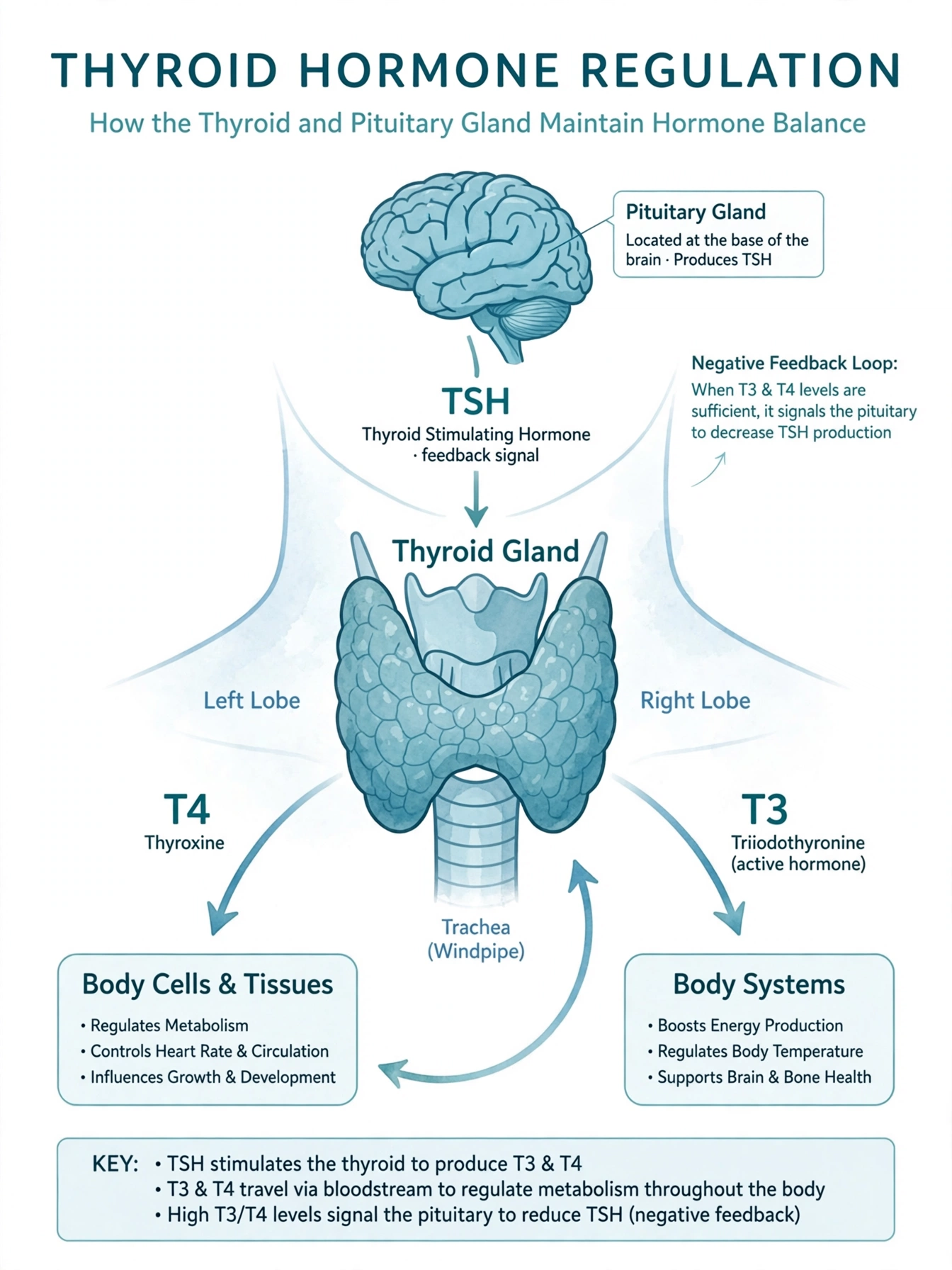
TSH stands for thyroid-stimulating hormone. It is not made by the thyroid gland itself — it is released by the pituitary gland, a small gland at the base of the brain. Think of TSH as a messenger: it travels through the blood and tells the thyroid how much hormone to produce.
The relationship works like a thermostat. When thyroid hormone levels in the blood drop, the pituitary typically releases more TSH to stimulate the thyroid. When thyroid hormone levels are high, TSH release is usually reduced. Because of this feedback loop, TSH is often the most sensitive early indicator that something in the system has shifted — it can change before T3 and T4 move noticeably.
T4 (Thyroxine): The Main Product
T4, or thyroxine, is the main hormone produced by the thyroid gland. Most of it travels through the blood attached to proteins; a small fraction circulates “free” — unattached and biologically active. Reports usually show Free T4, which is the clinically useful measurement, though some panels report Total T4.
T4 acts as a reservoir. The body’s tissues convert T4 into T3 as needed, which is why T4 levels give a good picture of the thyroid’s overall output.
T3 (Triiodothyronine): The Active Form
T3 is the more potent, active form of thyroid hormone. Most of it is created outside the thyroid gland, when tissues convert T4 into T3. Like T4, it is usually reported as Free T3.
In routine thyroid assessment, Free T3 is less central than TSH and Free T4. Doctors may pay closer attention to it in specific situations, such as when evaluating certain thyroid conditions or monitoring treatment — your doctor will decide which markers matter in your case.
Typical Reference Ranges
Reference ranges vary between laboratories, methods, and populations, so always use the range printed on your own report. As a general orientation, commonly used adult ranges are approximately:
| Marker | Typical adult range |
|---|---|
| TSH | 0.4 – 4.0 mIU/L |
| Free T4 | 0.8 – 1.8 ng/dL |
| Free T3 | 2.3 – 4.2 pg/mL |
These are approximate and illustrative only. Ranges differ for pregnant women, children, and older adults, and each laboratory sets its own. A value slightly outside the printed range does not automatically indicate a problem — your doctor interprets it alongside your symptoms, history, and other findings.
Why Your Doctor Reads Them Together
A single thyroid marker rarely tells the whole story. Doctors look at the pattern across all three:
- The direction of TSH relative to T4 and T3 (the feedback loop described above)
- How far values are from the reference range
- Trends over time — whether values are stable or changing across repeat tests
- Your clinical picture — symptoms, medications, pregnancy, and other conditions that can influence thyroid readings
This is why self-interpretation can be misleading. Two people with the same TSH value can need completely different advice depending on context. Always discuss your report with your doctor rather than drawing conclusions from the numbers alone.
How to Prepare for the Test
- Fasting: Usually not required, but follow your doctor’s instructions.
- Timing: A morning sample is often preferred for consistency.
- Medications and supplements: Some medicines and supplements (including biotin) can affect thyroid readings. Inform your doctor about everything you take.
- Acute illness: Thyroid levels can shift temporarily during severe illness; doctors usually prefer to test when you are stable.
Medical Disclaimer
This article is for general information only and is not medical advice. Reference ranges vary between laboratories, and thyroid reports must be interpreted by your doctor in the context of your overall health. Do not start, stop, or change any medication based on this article. If you have questions about your thyroid report, please consult your doctor.
Book Your Thyroid Test at Aura Care Centre
Aura Care Centre offers thyroid profile testing (T3, T4, TSH) with accurate, timely reports, plus home blood sample collection across Gurugram. Visit our branches in Sector 38, Sector 15, or Sector 51 — or call +91 81301 01433 / message us on WhatsApp to book your test or arrange a home collection.