
A standard chest X-ray gives a useful overview of the lungs, but sometimes your doctor needs far more detail — the fine structure of the lung tissue itself. That’s where HRCT (High-Resolution Computed Tomography) of the chest comes in.
Here’s what the test is, what it reveals, and what to expect.
What Is an HRCT Chest Scan?
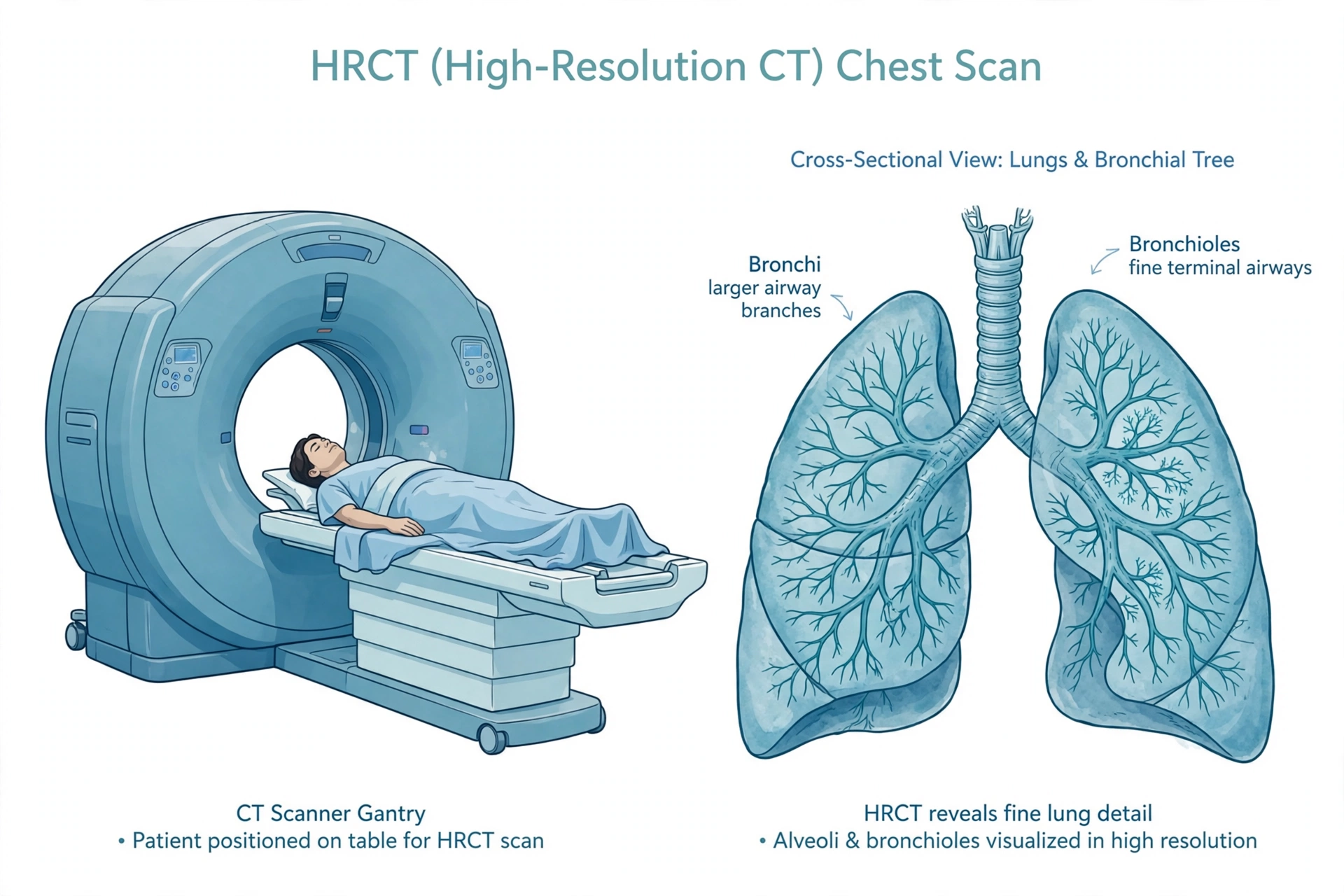
HRCT is a specialised form of CT scanning optimised for the lungs. While a routine CT takes relatively thick slices of the body, HRCT acquires very thin slices — typically 1 to 1.5 mm — which reveal the lung’s fine architecture: the airways, the tiny walls between air sacs, and subtle patterns of disease that thicker slices would blur together.
The scan is usually performed without contrast (no injection needed), takes only a few minutes of actual scanning, and produces hundreds of detailed cross-sectional images for the radiologist to analyse.
What Does HRCT Show That an X-Ray Doesn’t?
A chest X-ray compresses the entire 3D chest into a single flat image — ribs, heart, and lung tissue all overlap. HRCT eliminates this overlap and shows:
- Lung parenchyma in fine detail — the actual texture of lung tissue, where early disease first appears
- Interstitial patterns — thickening or scarring of the delicate walls between air sacs (as in interstitial lung disease or pulmonary fibrosis)
- Bronchiectasis — permanently widened, damaged airways
- Small nodules — lung nodules just a few millimetres wide that an X-ray would miss
- Emphysema — areas where lung tissue has been destroyed, seen as abnormal dark pockets
- Infections and inflammation — the extent and pattern of pneumonias, including post-viral lung changes
- Pleural abnormalities — thickening or fluid around the lung lining
In short: where an X-ray shows that something is abnormal, HRCT usually shows exactly what and where.
When Do Doctors Commonly Recommend HRCT Chest?
Doctors typically advise HRCT when they need a detailed assessment of lung disease. Common situations include:
- Evaluating interstitial lung disease (ILD) — HRCT is the key test for diagnosing and characterising ILD and pulmonary fibrosis, showing the specific pattern of scarring
- Unexplained breathlessness or persistent cough — when basic tests don’t explain the symptoms, HRCT can reveal underlying lung disease
- Following up known lung conditions — to check whether disease is stable, improving, or progressing
- Assessing bronchiectasis — to map which airways are affected and how severely
- Characterising lung nodules — to examine a nodule’s size, shape, and features in detail
- Post-infection evaluation — to assess residual lung changes after severe respiratory infections
The decision is always clinical — your doctor weighs your symptoms, examination, X-ray, and lung function tests before advising HRCT.
How Should You Prepare?
Preparation is straightforward:
- No fasting is required for a standard non-contrast HRCT chest
- Remove metal objects from the chest area — necklaces, and clothing with metal buttons or underwires. You’ll likely change into a gown
- Inform the centre if you are pregnant or might be pregnant, as CT uses X-rays
- Carry your prescription, previous X-rays/CT scans, and relevant reports — comparison with old images is extremely valuable
- If you have breathing difficulty, mention it — the scan needs you to hold your breath for a few seconds at a time, and the technologist will guide you
What Happens During the Scan?
You lie on your back on the scanner table, which slides into the CT gantry (a large ring — much shorter and more open than an MRI tunnel). The technologist positions you and then operates the scanner from an adjacent room, staying in voice contact throughout.
You’ll be asked to hold your breath for about 5–10 seconds several times while images are acquired — this freezes lung motion for sharp images. Between breath-holds, you breathe normally. The table may move slightly between acquisitions.
The whole appointment usually takes 10–15 minutes, with only a few minutes of actual scanning. It’s painless, and you can resume normal activities immediately.
What About Radiation?
CT scans use X-rays, so there is a small radiation dose involved. A few honest points:
- HRCT chest is a relatively low-dose CT examination, and modern scanners use dose-reduction technology to keep exposure as low as reasonably achievable
- The dose from a single HRCT is small compared to the natural background radiation you’re exposed to every year
- The medical benefit — an accurate diagnosis that guides treatment — far outweighs the small theoretical risk when the scan is medically advised
- It should not be done casually or repeatedly without a doctor’s indication
If you’re concerned about radiation, discuss it with your doctor — they can explain why the scan is worthwhile in your specific case.
Understanding Your Report
The radiologist’s report will describe the lung findings in technical terms — patterns like “reticulation,” “ground-glass opacities,” “honeycombing,” or “bronchial wall thickening.” These terms describe patterns, not diagnoses by themselves; your doctor interprets them in the context of your symptoms and other tests.
Don’t try to decode the report alone — take it to the doctor who advised the scan, and ask them to walk you through what it means for you.
Medical Disclaimer
This article is for general information only and is not a substitute for professional medical advice, diagnosis, or treatment. Whether you need an HRCT chest scan should always be decided by your doctor based on your clinical situation. Never delay seeking medical care because of something you read here.
Book Your HRCT Chest Scan at Aura Care Centre
Aura Care Centre performs HRCT chest scans on an advanced low-radiation multi-slice CT scanner, with detailed reports by qualified radiologists and fast digital delivery. Visit us at our centres in Sector 38, Sector 15, or Sector 51, Gurugram. Call or WhatsApp us at +91 81301 01433 to book your appointment.