
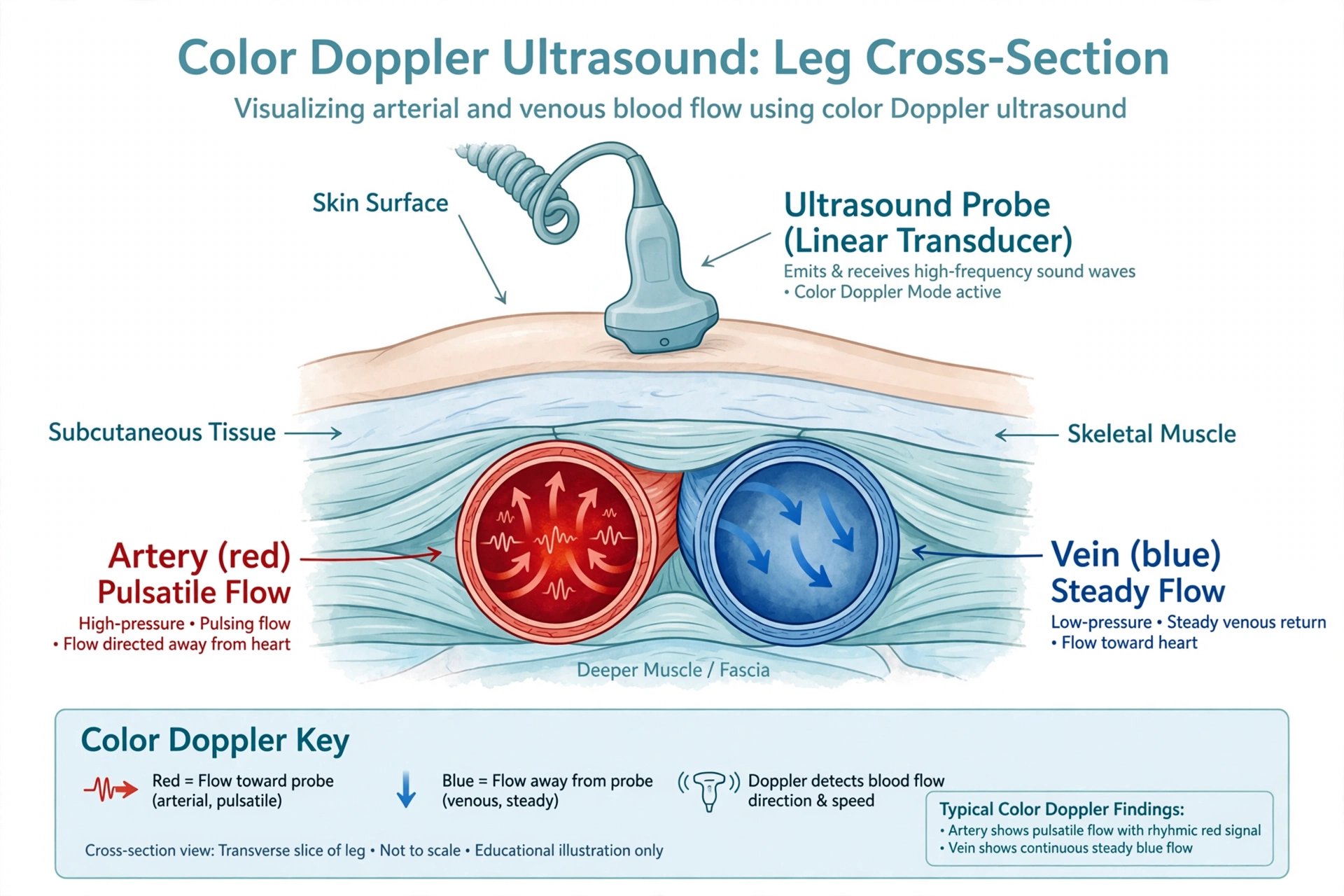
If your prescription says “arterial Doppler” or “venous Doppler” (or both), you might wonder what the difference is — after all, both use the same machine. The difference lies in which blood vessels are being studied and what the doctor is looking for.
This guide explains both, in plain language.
What Is a Color Doppler Test?
A Doppler ultrasound is a specialised form of ultrasound that visualises blood flow — not just the shape of organs, but the movement of blood through arteries and veins. On the screen, flow toward the probe appears in one colour (usually red) and flow away in another (usually blue), which is where the “color” in the name comes from.
Beyond the colours, the machine measures the speed and pattern of flow and can detect turbulence, blockages, narrowing, or reversed flow. Like all ultrasound, it uses sound waves — no radiation, no injections, no known side effects.
Arterial Doppler: Studying the Arteries
Arteries carry oxygen-rich blood away from the heart to the body’s tissues. An arterial Doppler examines these vessels for narrowing, blockages, or abnormal flow patterns.
Common arterial Doppler studies include:
- Carotid Doppler — examines the carotid arteries in the neck, which supply blood to the brain. Doctors may advise it when evaluating stroke risk factors or a neck bruit (a whooshing sound heard on examination).
- Lower limb arterial Doppler — examines the arteries of the legs. It is commonly advised when a patient reports leg pain or cramping while walking that eases with rest, non-healing foot wounds, or when the doctor suspects reduced blood supply to the limbs.
- Upper limb arterial Doppler — examines the arm arteries, less commonly advised, for similar concerns in the arms.
- Renal artery Doppler — examines the arteries supplying the kidneys, sometimes advised in the workup of difficult-to-control blood pressure.
During an arterial Doppler, the sonologist also measures pressures at different levels (for example, ankle vs arm) in some protocols, and listens to the waveform patterns — healthy arteries produce a characteristic crisp, three-phase waveform.
Venous Doppler: Studying the Veins
Veins carry blood back toward the heart. A venous Doppler examines these vessels, focusing on clots, valve function, and flow direction.
Common venous Doppler studies include:
- Lower limb venous Doppler — the most common venous study. It checks the leg veins for blood clots (deep vein thrombosis), usually advised when there is unexplained leg swelling, pain, or redness. It also evaluates the valves in the veins, which prevent blood from flowing backward.
- Venous insufficiency / varicose vein mapping — examines how well the vein valves work and maps which veins are affected, often done before varicose vein treatment so the surgeon knows exactly what to treat.
- Upper limb venous Doppler — examines arm veins, sometimes advised when there is arm swelling, particularly in patients with IV lines or catheters.
A key part of the venous examination is the compression test: the sonologist gently presses the probe against the vein. A healthy vein collapses completely under pressure; a vein containing a clot does not. The sonologist also checks whether blood flows backward when you bear down or when the leg is squeezed — a sign of valve failure.
Arterial vs Venous: The Key Differences at a Glance
| Arterial Doppler | Venous Doppler | |
|---|---|---|
| Vessels studied | Arteries (heart → tissues) | Veins (tissues → heart) |
| Main question | Is there narrowing or blockage reducing flow? | Is there a clot, or are valves failing? |
| Key technique | Waveform analysis, velocity measurements | Compression test, reflux check |
| Common sites | Carotids (neck), leg arteries | Leg veins |
| Urgency | Usually scheduled routinely | Sometimes urgent, when a clot is suspected |
Note that both studies are sometimes done together — for example, a “bilateral lower limb arterial + venous Doppler” examines the complete circulation of both legs.
How Should You Prepare?
Preparation is usually minimal:
- No fasting is required for limb or carotid Doppler studies
- Abdominal or renal Doppler may need 6–8 hours of fasting (gas obscures the view) — confirm when booking
- Wear loose clothing that allows easy access to the area being examined
- Carry your prescription and any previous Doppler or ultrasound reports for comparison
- The study typically takes 20 to 45 minutes, depending on how many areas are examined
What Happens During the Test?
You’ll lie on an examination couch while gel is applied to the skin over the area being studied. The sonologist moves the probe along the vessels, pausing to take measurements. You may hear a whooshing sound from the machine’s speaker — that’s the audible Doppler signal of your blood flow, and it’s completely normal.
For venous studies, the sonologist will press the probe firmly at intervals (the compression test) and may ask you to bear down briefly or squeeze your calf muscles. For arterial studies of the legs, blood pressure cuffs may be placed at several levels.
There are no needles, no contrast, and no recovery time — you can go straight back to your day.
Medical Disclaimer
This article is for general information only and is not a substitute for professional medical advice, diagnosis, or treatment. Whether you need an arterial Doppler, a venous Doppler, or both — and what the findings mean — should always be decided with your doctor. If you have sudden leg swelling, pain, or redness, seek medical attention promptly rather than waiting for a routine appointment.
Book Your Doppler Study at Aura Care Centre
Aura Care Centre performs arterial and venous Color Doppler studies on advanced ultrasound systems, with detailed reports by qualified radiologists and same-day digital delivery. Visit us at our centres in Sector 38, Sector 15, or Sector 51, Gurugram. Call or WhatsApp us at +91 81301 01433 to book your appointment.