
If your doctor has advised a TVS (transvaginal sonography) scan, you may have questions: what exactly happens, how should you prepare, and is it painful? This guide answers the common questions in plain language so you can walk in feeling prepared and at ease.
What Is a TVS Scan?
A transvaginal ultrasound is a pelvic imaging test in which a slim ultrasound probe is gently placed inside the vagina to get a close, detailed view of the uterus, ovaries, fallopian tubes, and surrounding pelvic structures.
Because the probe sits close to the organs being examined — and uses a higher-frequency sound wave than an abdominal probe — TVS produces clearer, more detailed images of the pelvis than a scan done through the abdomen. It uses sound waves, not radiation, and is considered safe, including in early pregnancy when your doctor advises it.
Why Do Doctors Recommend a TVS Scan?
Doctors commonly advise TVS when they need a detailed look at the pelvic organs. Common reasons include:
- Evaluating the uterus lining (endometrium) and detecting fibroids or polyps
- Checking the ovaries for cysts or other findings
- Monitoring follicle growth during fertility treatment or ovulation tracking
- Assessing pelvic pain or abnormal bleeding, as part of the overall workup
- Confirming an early pregnancy (around 6–8 weeks) and checking the embryo’s viability
- Measuring cervical length during pregnancy, when advised
Your doctor will explain why the scan has been recommended in your case. The scan itself does not diagnose on its own — the findings are interpreted together with your symptoms, examination, and other tests.
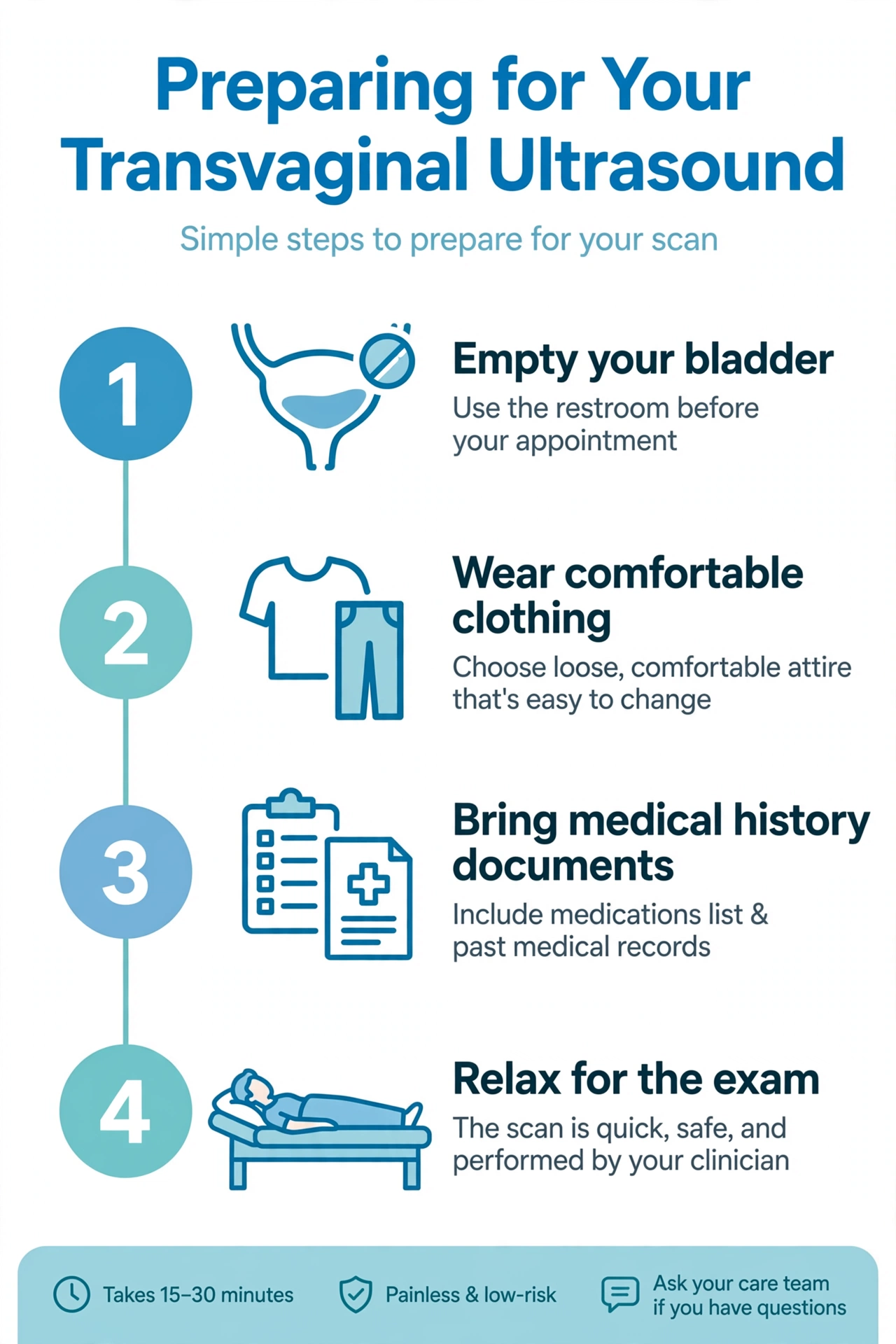
How Should You Prepare?
Preparation for a TVS scan is simple:
- Empty your bladder before the scan. Unlike an abdominal pelvic ultrasound (which needs a full bladder), TVS gives the clearest images with an empty bladder.
- Wear comfortable clothing — a skirt or loose trousers and a top work well, since you’ll undress from the waist down in privacy.
- Carry your prescription and previous reports, including earlier ultrasounds and relevant blood test reports, so the sonologist has context.
- No fasting is required. You can eat and drink normally before the scan.
- The scan itself usually takes 10 to 20 minutes.
If you are menstruating, the scan can generally still be performed — inform the centre when booking so they can advise you. If you have any vaginal infection or are feeling unwell, mention it beforehand.
What Happens During the Scan?
You’ll be taken to a private examination room. You’ll be asked to undress from the waist down and lie on the examination couch, usually with a sheet draped over you for modesty. A female attendant is typically present throughout.
The sonologist covers the slim probe with a protective sheath and applies lubricating gel, then gently inserts it a short distance into the vagina. The probe is moved slightly to view the uterus and ovaries from different angles. Images appear on a monitor, which you can usually see.
Most women describe the sensation as mild pressure or slight discomfort rather than pain. If you feel pain at any point, tell the sonologist immediately — the examination can be paused or adjusted. Afterwards, you can get dressed and resume your normal activities straight away; there is no recovery time.
Is a TVS Scan Safe in Early Pregnancy?
Yes — transvaginal ultrasound is widely used in early pregnancy and is considered safe when performed on your doctor’s advice. The probe does not touch the uterus itself and does not harm the embryo. It is often the preferred method in the first trimester because it can detect the gestational sac and embryo earlier and more clearly than an abdominal scan.
As with any test in pregnancy, it should be done when your doctor considers it medically appropriate — not as a routine without indication.
Common Concerns, Answered Honestly
Will it hurt? For most women, no. You may feel pressure or brief discomfort, especially if the pelvic area is tender. Communicate with the sonologist throughout.
Will it affect virginity or the hymen? This is a common concern. TVS is generally advised for women who are sexually active. If you have concerns, discuss them with your doctor before the scan — a transabdominal ultrasound may be suggested as an alternative in some situations.
Can I do it during my period? Usually yes, though some women prefer to schedule around it for comfort. Check with the centre.
How soon will I get the report? In most diagnostic centres, the report is available the same day, often within an hour or two.
Medical Disclaimer
This article is for general information only and is not a substitute for professional medical advice, diagnosis, or treatment. Whether you need a TVS scan, and what its findings mean, should always be decided with your doctor. Never delay seeking medical advice because of something you read here.
Book Your TVS Scan at Aura Care Centre
Aura Care Centre offers transvaginal ultrasound scans in a private, comfortable setting with experienced sonologists and same-day digital reports. Visit us at our centres in Sector 38, Sector 15, or Sector 51, Gurugram. Call or WhatsApp us at +91 81301 01433 to book your appointment.